Written by Bob Martin and Chad Beguelin
Directed by Ryan Murphy
Available to stream now on Netflix
Actors have famously used their fame as clout to bring attention to serious and important causes, believing that their endorsement will help make this matter take on greater significance to a large number of people. One example was an incident in 2010 involving a teenage girl who wanted to take her girlfriend to their senior prom in Mississippi but where denied by school board. The girls pushed back and the board decided to cancel the prom instead of allowing them to attend. A lawsuit was filed and a Federal Court found the couple's First Amendment rights had been violated. However, the judge did not force the school to reinstate the prom. Some celebrities heard this story and jumped in to sponsor a fund-raiser so that the girls could attend an inclusive prom event.
This was the inspiration for the stage musical, "The Prom", created in 2016 by Bob Martin, Matthew Sklar and Chad Beguelin which would end up on Broadway two years later, winning critical praise and award recognition. Ryan Murphy, who almost single-handedly reinvigorated television by inventively bringing progressive stories and marginalized characters to the small screen, returns to feature films to direct a version of the musical with a cast of impressive major stars on board to spice up the production. But Murphy has taken a relatively small scale story and pumped it up in to a colossal explosion of overbearing sights, unremarkable sounds and gaudy colors. It is a politically-minded, musical spectacle that demands you pay attention yet in an obnoxious, "look at me! look at me!" sort of way.
During opening night on Broadway of the new musical, "Eleanor!: The Eleanor Roosevelt Story", stars, Dee Dee Allen (Meryl Streep), a two-time Tony Award winner and Barry Glickman (James Corden) are waiting for the reviews to come in for the play. With a rave from a critic in New Jersey, the team is convinced they have a winner on their hands and begin to celebrate. However, the review from the New York Times is ugly and brutal, effectively killing the show.
Depressed and wallowing in self-pity, Dee Dee and Barry drown their sorrows at a local bar where Julliard graduate, Trent Oliver (Andrew Rannells) works only between theater jobs which has been few and far between of late. Joining in to commiserate with them is Angie Dickinson (Nicole Kidman), a long-time chorus girl who has just quit her job in "Chicago", frustrated by never getting a chance to play one of the leads. They decide to find a cause that will make them appear to be caring people and deliver them plenty of much-needed publicity. Angie finds the perfect case happening in a small town in Indiana, leading them to quickly head out to save the day.
Emma Nolan (Jo Ellen Pellman) is at the center of the dilemma at her high school. As an open lesbian, the teen wants to bring her female date to the prom but the head of the school PTA, Mrs. Greene (Kerry Washington) announces she will cancel the dance instead of allowing that to happen. The only one on Emma's side is the principal, Mr. Hawkins (Keegan-Michael Key) yet he's unable to stop the board about the prom.
Our four stage actors burst into the PTA meeting, outraged by the decision and demand justice for the lesbians. No one in town really knows what to make of these frivolous, self-involved performers but they won't leave. The actors befriend Emma, determined to help her so that will help them in their goal of getting some great press. Meanwhile, there is a little sexual tension simmering between Principal Hawkins (who is a big fan of the actress) and Dee Dee. And Emma's date is secretly the popular cheerleader, Alyssa (Ariana DeBose), the daughter of Mrs. Greene, who had decided to use the prom to publicly come out of the closet.
The major problem with "The Prom" is that it's not nearly as much fun as it thinks it is. You can see all the effort put in to this whirling, hyper-colored fantasia yet the payoff is minor and extremely disappointing, It's clear Murphy had difficulty figuring out how to merge the lives of wacky, over-the-top, self-indulgent theater actors with the more somber political statements involving inclusivity and tolerance. And the film suffers under the weight of trying to make the story bigger and louder than it really needed to be.
The staging of the musical numbers are hampered by poor blocking and odd location settings. The dance sequences are far too slick and robotic to make any impact. The key to any successful musical, obviously, are the songs. And while the songs in "The Prom" (with music by Matthew Sklar and lyrics from Chad Beguelin) certainly moves our story forward, they felt only serviceable, leaving no lasting memory beyond the film. It doesn't help that many of the actors deliver these tunes loudly, without much subtilty or emotional investment.
It's no real surprise that Ms Streep is the best thing here. Looking an awful lot like a bedazzled Shirley MacLaine, it's always fun watching La Streep mugging while kicking up her heels and belting out a song. Ms Kidman is another one breaking out of her dramatic comfort zone and joyfully delivering her big solo number, "Zazz", full of jazz hands and Fosse-styled dance moves. They are clearly enjoying themselves yet we are left only mildly satisfied. I was less offended by Mr. Corden's performance than by the fact that he always seemed like he was delivering a performance. The popular late-night television host never for a moment comes across convincingly as a narcissistic gay actor. You can actually see him at times struggling to figure out how big he should go. And I'm gonna repeat what I've heard a few people say which is Mr. Cordon was in a role that seemed tailor-made for Nathan Lane who could have brought an effortless charm and outrageousness that was sadly lacking here.
"The Prom" seemed like a movie that would be right up my alley, featuring an inventive director, a positive story involving love and tolerance and a cast of some of my favorite actors singing and dancing. I really, really wanted to find comfort and enjoyment from this timely musical yet all I was left feeling was numb and brutalized.
Saturday, December 26, 2020
Monday, December 21, 2020
AWARD SEASON NEWS
Film critics are beginning to announce their selections for the best in cinema in 2020. The LA Film Critics Association selected yesterday "Small Axe", a collection of five films directed by Oscar-winner Steve McQueen, as Best Picture and Best Cinematography for Shabier Kirchner who filmed all five parts. While last week, The New York Film Critics Circle picked "First Cow", Kelly Reichardt's 19th century drama about a cook heading out West seeking his fortune, as Best Film while the Boston Society of Film Critics selected as their Best Picture, "Nomadland", which stars Frances McDormand as a woman who leaves her small town to travel around the American West from Chloé Zhao, who also won Best Director here and with New York.
Other films being recognized by these groups and generating some early buzz are the film adaptation of August Wilson's play, "Ma Rainey’s Black Bottom" and it's stars, Viola Davis, Glynn Turman and the late, Chadwick Boseman; writer/director, Emerald Fennell's feature film debut, "Promising Young Woman" which stars Carey Mulligan; "Never Rarely Sometimes Always", a drama from writer/director, Eliza Hittman, that follows a teenager making the difficult decision to end her unplanned pregnancy and "Wolfwalkers", the hand-drawn animated feature film about the unlikely friendship between an apprentice wolf hunter and a mysterious young girl who has the ability to transform into a wolf by night.
And the European Film Awards selected their winners with Thomas Vinterberg's "Another Round" sweeping the major awards with Best European Film, Best Director, Best Screenwriter (for Vinterberg and Tobias Lindholm) and Best Actor for star, Mads Mikkelsen.
Winners from the Los Angeles Film Critics Association:
Best Picture: "Small Axe" (all five films)
Best Director: Chloé Zhao, "Nomadland"
Best Screenplay: Emerald Fennell, "Promising Young Woman"
Best Actress: Carey Mulligan, "Promising Young Woman"
Best Actor: Chadwick Boseman, "Ma Rainey’s Black Bottom"
Best Supporting Actress: Yuh-jung Youn, "Minari"
Best Supporting Actor: Glynn Turman, "Ma Rainey’s Black Bottom"
Best Documentary/Non-Fiction: "Time"
Best Foreign Language Film: "Beanpole"
Best Animated Film: "Wolfwalkers"
Best Cinematography: Shabier Kirchner, "Small Axe" (all films)
Best Editing: Yorgos Lamprinos, "The Father"
Best Production Design: Donald Graham Burt, "Mank"
Best Music/Score: Trent Reznor and Atticus Ross, "Soul"
New Generation Prize: Radha Blank, "The Forty-Year-Old Version"
Winners from the New York Film Critics Circle:
Best Film: "First Cow"
Best Director: Chloé Zhao, "Nomadland"
Best Screenplay: Eliza Hittman, Never Rarely Sometimes Always"
Best Actress: Sidney Flanagan, "Never Rarely Sometimes Always"
Best Actor: Delroy Lindo, "Da 5 Bloods"
Best Supporting Actress: Maria Bakalova, "Borat Subsequent Moviefilm"
Best Supporting Actor: Chadwick Boseman, "Da 5 Bloods"
Winners from the Boston Society of Film Critics:
Best Picture: "Nomadland"
Best Director: Chloe Zhao, "Nomadland"
Best Screenplay: Charlie Kaufman, "I’m Thinking of Ending Things"
Best New Filmmaker: Florian Zeller, "The Father"
Best Actor: Anthony Hopkins, "The Father"
Best Actress: Sidney Flanigan, "Never Rarely Sometimes Always"
Best Supporting Actor: Paul Raci, "Sound of Metal"
Best Supporting Actress: Youn Yuh-jung, "Minari"
Best Ensemble Cast: "Ma Rainey’s Black Bottom"
Best Documentary: "Collective"
Best Non-English Language Film: "La Llorona"
Best Animated Film: "The Wolf House"
Best Cinematography: Joshua James Richards, "Nomadland"
Best Film Editing: Robert Frazen, "I’m Thinking of Ending Things"
Best Original Score: Emile Mosseri, "Minari"
Best Film: "First Cow"
Best Director: Chloé Zhao, "Nomadland"
Best Screenplay: Eliza Hittman, Never Rarely Sometimes Always"
Best Actress: Sidney Flanagan, "Never Rarely Sometimes Always"
Best Actor: Delroy Lindo, "Da 5 Bloods"
Best Supporting Actress: Maria Bakalova, "Borat Subsequent Moviefilm"
Best Supporting Actor: Chadwick Boseman, "Da 5 Bloods"
Best First Film: "The 40 Year Old Version"
Best Foreign-Language Film: "Bacurau"
Best Non-Fiction Film: "Time"
Best Animated Film: "Wolfwalkers"
Best Cinematography: Shabier Kirchner, "Small Axe" (all films)
Best Foreign-Language Film: "Bacurau"
Best Non-Fiction Film: "Time"
Best Animated Film: "Wolfwalkers"
Best Cinematography: Shabier Kirchner, "Small Axe" (all films)
Winners from the Boston Society of Film Critics:
Best Picture: "Nomadland"
Best Director: Chloe Zhao, "Nomadland"
Best Screenplay: Charlie Kaufman, "I’m Thinking of Ending Things"
Best New Filmmaker: Florian Zeller, "The Father"
Best Actor: Anthony Hopkins, "The Father"
Best Actress: Sidney Flanigan, "Never Rarely Sometimes Always"
Best Supporting Actor: Paul Raci, "Sound of Metal"
Best Supporting Actress: Youn Yuh-jung, "Minari"
Best Ensemble Cast: "Ma Rainey’s Black Bottom"
Best Documentary: "Collective"
Best Non-English Language Film: "La Llorona"
Best Animated Film: "The Wolf House"
Best Cinematography: Joshua James Richards, "Nomadland"
Best Film Editing: Robert Frazen, "I’m Thinking of Ending Things"
Best Original Score: Emile Mosseri, "Minari"
Winners of the 2020 European Film Awards:
Best European Film: "Another Round"
Best European Director: Thomas Vinterberg, "Another Round"
Best European Screenwriter: Thomas Vinterberg and Tobias Lindholm, "Another Round"
Best European Actress: Paula Beer, "Undine"
Best European Actor: Mads Mikkelsen, "Another Round"
Best European Discovery (Prix Fipresci): Carlo Sironi, "Sole"
Best European Comedy: "The Big Hit"
Best European Documentary: "Collective"
Best European Animated Feature: "Josep"
Best European Short Film: "All Cats Are Grey in the Dark"
Best European Cinematography: Matteo Cocco, "Hidden Away"
Best European Editing: Maria Fantastica Valmori, "Once More Unto the Breach"
Best European Production Design: Cristina Casali, "The Personal History of David Copperfield"
Best European Costume Design: Ursula Patzak, "Hidden Away"
Best European Make-Up & Hair: Yolanda Piña, Félix Terrero and Nacho Diaz, "The Endless Trench"
Best European Original Score: Dascha Dauenhauer, "Berlin Alexanderplatz"
Best European Sound: Yolande Decarsin, Kristian Selin and Eidnes Andersens, "Little Girl"
Best European Visual Effects: Inaki Madariaga, "The Platform"
EFA Award for Innovative Storytelling: Mark Cousins, "Women Make Films"
Friday, December 18, 2020
GREAT PERFORMANCES: THE BEST ACTORS OF 2020
There's no need to remind anyone of the challenges that was placed on entertainment this year, especially with the movies. The annual "Great Performers" issue in the New York Times magazine has usually focused on film work yet due to a significant shortage of theatrical movies released throughout the year, the critics, A.O. Scott and Wesley Morris had to get creative and expand beyond cinema. There were certainly some great performances in feature films to highlight like Julia Garner in "The Assistant" that was released earlier in the year before the shutdown; Luca Marinelli in the Italian feature, "Martin Eden"; Viola Davis's electrifying turn in "Ma Rainey's Black Bottom"; Andy Samberg and Cristin Millioti in the sci-fi, romantic-comedy, "Palm Springs"; the precocious, Fathia Youssouf in the controversial French drama, "Cuties" and the legendary Sophia Loren's glorious return before the cameras (thanks to her son, director Edoardo Ponti) in "The Life Ahead".
But now we have some great television performances from Zoë Kravitz in "High Fidelity"; the very intense Ethan Hawke in "The Good Lord Bird"; Jason Sudeikis starring in the sitcom, "Ted Lasso" about an American football coach trying to lead an English football club; Maitreyi Ramakrishnan in "Never Have I Ever"; Jack Dylan Grazer and Jordan Kristine Seamon in Luca Guadagnino's soapy, limited-series drama, "We Are Who We Are" and the beautifully understated work by Zoe Kazan in the stirring mini-series, "The Plot Against America".
We have female storytellers using their lives as inspiration with writer/director/star, Radha Blank and her feature film debut, "The 40 Year Old Version"; Hannah Gadsby in her offbeat, stand-up comedy special, "Douglas"; Maya Erskine and Anna Konklein with the second season of their cringe-comedy series, "Pen15"; and Michaela Coel and her harrowing yet hilarious limited series, "I May Destroy You".
The importance of social media is acknowledged here with comedians, Sarah Cooper, Jeff Wright, Kylie Brakeman and Blaire Erskine who all found fame and success on TikTok and Twitter. And there was even room to honor an extraordinary performance from the past with Cher's Oscar-winning turn in the beloved 1987 romantic-comedy, "Moonstruck".
Please click below to read:
NYT Great Performers 2020
Monday, December 14, 2020
2020 NATIONAL FILM REGISTRY
The Library of Congress has added twenty-five movies to the National Film Registry which recognizes their artistic significance while helping to ensure their preservation for generations to come. This year some of the films selected include the musical-comedy, "The Blues Brothers"; the second installment of Christopher Nolan's groundbreaking Batman trilogy, "The Dark Knight"; the 2008 Best Picture winner, "The Hurt Locker" which was directed by the first woman to win the Best Director Oscar, Kathryn Bigelow; "Shrek", the computer-animated classic about a nasty ogre who falls in love with a princess; Sidney Poitier plays a former GI that a group of nuns believe has been sent by God to build them a new chapel in "Lillies of The Field" which the role made him the first African-American to win the Best Actor Oscar; the early blaxploitation action thriller, "Sweet Sweetback’s Baadasssss Song" which starred and was directed by Melvin Van Peebles; Based on the best-selling novel by Amy Tan, "The Joy Luck Club" follows four Chinese-American immigrant families in San Francisco and one of my all-time favorite movies, the screen-adaption of the Broadway musical, "Grease".
These films, which must be at least ten years old, have been named because of their cultural, historic or aesthetic importance and with these selections brings the number of films in the registry to 800. Here is the complete list of the films selected to the 2020 National Film Registry:
"The Battle Of The Century" (1927)
"The Blues Brothers" (1980)
"Bread" (1918)
"Buena Vista Social Club" (1999)
"Cabin In The Sky" (1943)
"A Clockwork Orange" (1971)
"The Dark Knight" (2008)
"The Devil Never Sleeps" (1994)
"Freedom Riders" (2010)
"Grease" (1978)
"The Ground" (1993-2001)
"The Hurt Locker" (2008)
"Illusions" (1982)
"The Joy Luck Club" (1993)
"Kid Auto Races At Venice" (1914)
"Lilies Of The Field" (1963)
"Losing Ground" (1982)
"The Man With the Golden Arm" (1955)
"Mauna Kea: Temple Under Siege" (2006)
"Outrage" (1950)
"Shrek" (2001)
"Suspense" (1913)
"Sweet Sweetback’s Baadasssss Song" (1971)
"Wattstax" (1973)
"With Car And Camera Around The World" (1929)
Sunday, December 13, 2020
MY VIEWING DIARY: PART ELEVEN
"My Brilliant Career" (1979)
One of the highlights during the Australian cinematic New Wave, "My Brilliant Career" was the feature film debut of Gillian Armstrong which also introduced to the world the amazing talents of Sam Neill and Judy Davis. Set in 19th century Australia, our story follows Sybylla (Davis), a young woman living on an isolated country farm with her family. Headstrong and chafing against the societal conventions on how women are expected to act, she dreams of having a career in the arts, possibly as a writer. Sybylla's exasperated parents decide to send her off to live with her wealthy grandmother (Aileen Britton) in the city with the hopes she will learn how to behave like a proper, upstanding young woman and get married. But that does not happen, in fact Sybylla becomes to feel even stronger in her convictions as a nonconformist. Sybylla captures the attention of two men; Frank Hawdon (Robert Grubb), a local sheep rancher who she has no romantic interest in and a wealthy family friend, Harry Beecham (Neill) that she finds herself becoming enamored with. But Sybylla is soon torn between following her amorous heart or pursuing a desire to follow her own path in life.
Based on a novel by Miles Franklin, "My Brilliant Career" was a perfect vehicle to showcase the filmmaking gifts of Ms Armstrong. The director's first film is an assured effort, told with great passion and heartfelt emotions. As she would further display in her future work in "Starstruck", "Mrs. Soffel" and the 1994 version of "Little Women", Armstrong's career would focus almost entirely on female protagonists, telling the little-told and much-needed narratives of women who refused to bend easily to tradition, determined to find their own voices and demanding for them to be heard. And with only her second film at the time, Ms Davis displays a commanding screen presence, capturing the fiercely independent yet deeply vulnerable spirit of a young woman who dared to question the limitations society had placed upon her solely because of her gender.
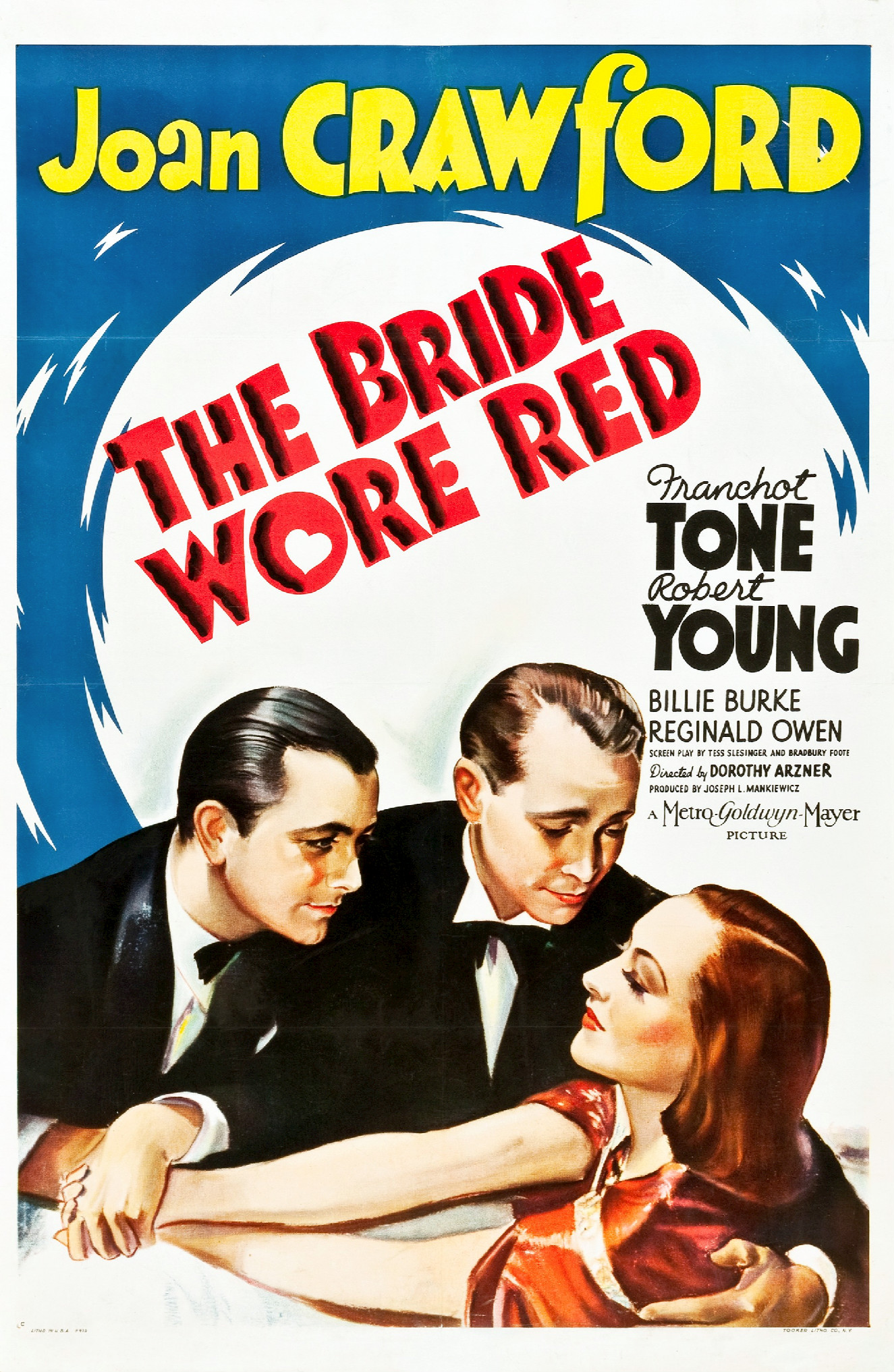
"The Bride Wore Red" (1937)
"The Bride Wore Red" is a routine 1930's Hollywood romantic-comedy that's only notable for marking the beginning of Joan Crawford's period of decline as a movie star (eventually being labeled "box-office poison") and being directed by the only woman working behind the camera during this era, Dorothy Arzner. Crawford plays Anni Pavlovitch, a singer at a sleazy nightclub in Trieste. She gets caught up in the amusement of a cynical Count Armalia (George Zucco) as he wants to prove a point to his friend, Rudi Pal (Robert Young who would later become better known on the television shows, "Father Knows Best" and "Marcus Welby, M.D."). With the belief that the only difference between the wealthy and the poor is a lot of luck, the Count arranges for Anni to spend two weeks living the good life at a glamourous resort hotel in the Alps. Posing as "Anne Vivaldi", a friend of the Count and daughter of an aristocrat, Anni takes quickly to the comforts of the rich. Rudi, unaware of this arrangement, sees "Anne" and becomes completely infatuated by her, despite being at the resort with his fiancée, Maddalena (Lynne Carver) and her parents (Reginald Owen, Billie Burke). But this soon turns in to a love triangle as a local postal clerk (Franchot Tone, Crawford's then-husband) also falls hard for Anni following their meeting during her arrival. Not wanting to give up this life of wealth and luxury, Anni struggles between snaring a rich yet unavailable man for security or following her heart for a man of more modest means.
While the gap between the wealthy and the working class has grown even wider since the film was made, I'm sure this farcical set-up was hard to swallow even back in 1937. Arzner has moments to shine as a filmmaker, eliciting great performances from her cast and subtly upending traditional views of women of the day. But the sluggish script by Tess Slesinger and Bradbury Foote works against her adding very little romance and barely any comedy. "The Bride Wore Red" is essentially nothing more than a star vehicle for Crawford and with only that in mind, the film is highly effective. With her looking stunning in dramatic, gorgeous costumes and displaying her lion in sheep's clothing screen persona, fans of this legendary actress will be thrilled. But for fans of amusing romantic-comedies, the thrills will be far more limited.
"The Perfection" (2019)
Bloody, gruesome and totally bonkers, "The Perfection" is a psychological thriller from co-writer and director, Richard Shepard that is filled with unexpected twists and insane turns. Charlotte Willmore (Allison Williams) is a gifted teenage cellist attending the prestigious music school, Bachoff in Boston. Her future looked promising but after her mother becomes gravely ill, she's forced to leave the academy. Years later, Charlotte is invited by Anton (Steven Weber), the director of Bachoff, to attend the selection of a new student in Shanghai. She meets Anton's current prize student, Lizzie (Logan Browning, star of the Netflix series, "Dear White People") and there is an instant connection between them. And their connection is so intense that after an evening of drinking and dancing, the ladies end up in bed together. This is where I should probably stop in order not to spoil what happens next as the story soars to histrionic and unhinged heights.
"The Perfection" plays like vintage Brian De Palma, ripe with a meticulously plotted story, high-tension melodrama, hyper-violence and overheated sexuality. But one key touch that Shepard employs is that once the story reaches a climatic moment, we visually rewind back to the beginning of the scene, revealing all of the hidden secrets and deceptions we were unaware had previously occurred. This happens twice in the film and while some may find this a bit of a cheat, there is no denying that it does knock you over with some shocking jolts.
"The Perfection" is certainly an inspired horror flick, shaking up convention and our expectations of what we have come to anticipate from the genre. But like some De Palma films, a little more care with the screenplay, in order for some key plot twists to seem less haphazard and other revelations to not feel so exploitive, would have made for a sharper and unforgettable thriller.
Monday, November 30, 2020
THE 25 GREATEST ACTORS OF THE 21ST CENTURY (SO FAR)
The crazy idea to name just twenty-five of the greatest actors of the twenty-first century is certainly a lofty and incredibly daunting proposition. But the chief film critics of the New York Times, A.O. Scott and Manohla Dargis have bravely taken on this challenge and selected the performers whose work over the last twenty years they have considered to be absolutely transformative experiences. Most of the actors on this list have been working long before the year 2000 but the focus was on their extraordinary work they have created specifically during this century.
I am certain there will be many who will be equally outraged by the selections and the omissions of actors on this highly subjective list. They are certain names on here I would not have put on my list and I might have rearranged the order. But regardless of all that, it is a thoughtful and intriguing selection that features a diverse and international group of actors that I'm sure many will agree have delivered several of the most outstanding and memorable performances of all time.
Please click below to read:
25 Greatest Actors of the 21st Century
Sunday, November 29, 2020
THE 40 YEAR OLD VERSION (2020)
Written & Directed by Radha Blank
Available to stream now on Netflix
All artists just want to be able to express themselves and share their creativity to the world. Due to talent, circumstances and a lot of luck, some people are fortunate enough to have their gifts noticed, appreciated and rewarded by a large audience. But there are others, despite their fierce determination and debatable skills, that are not as fortunate while spending many years struggling for someone to take notice and give them a chance.
Writer/director Radha Blank has cleverly built her debut feature film, "The 40 Year old Version" around her own experiences as an artist struggling for many years to be noticed, creating a comedy that is razor-sharp, heartfelt and a fitting showcase for a gifted emerging filmmaker.
Blank, feeling no need to be coy, stars as Radha, a New York playwright who is struggling to get her career off the ground. Once named one of the "Most Promising 30 Under 30" a number of years ago, she is now rapidly approaching forty with no real prospects in sight. Archie (Peter Y. Kim), Radha's sassy, gay friend since childhood is also her agent and one of her biggest supporters . He's pressuring her to meet with Josh Whitman (Reed Birney), a theater producer, to discuss getting behind her play. While Whitman claims to love her work and wants to produce it, he has few suggestions on ways to improve her play. Radha's reaction is unexpected (and a little violent), ending with her hands tightly around his throat.
Realizing that might not have been a great move to help her career yet it does lead Radha down a path to embarking on a new and unlikely career. No longer wanting to wait for approval from the gatekeepers nor make her work easier for white people to digest, she wants to express herself with an authentic voice through rap and hip-hop. Radha begins her journey on making a mixtape by acquiring some beats from a DJ named D (Oswin Benjamin). She finds ease in spitting out rhymes in an intimate setting yet is far less confident rapping in front of an audience, choking very badly during her first live performance. Quiet and unassuming, D patiently offers Radha words of encouragement and reveals to her the endless possibilities by taking her to see other female performers.
Radha also works with students at a high school to write and put on a play, trying to inspire a future generation for a love of the theater. But like many teenagers today, they are far too distracted with social media and their raging hormones to be that focused on the stage. Archie has managed to convince Whitman to overlook the choking incident (don't ask), with the producer still wanting to work with Radha. And while her dream has been to have her work produced on a theatrical stage, she's unsure if that's what she still wants to do under such oppressive artistic conditions.
On the surface, "The 40 Year Old Version" may not appear to be a particularly fresh idea for a comedy. Yet Blank delivers a fresh perspective on the creative process, in front of and behind the camera, dealing with race, gender and age in ways that are rarely seen or considered. With an impressive ability to indicate high production values from a small budget and visually inventive with crisp black and white cinematography from Eric Branco, Blank's film brings to mind the debut feature of another filmmaker from Brooklyn, Spike Lee. "She's Gotta Have It", Mr. Lee's 1986 comedy, focused on the independent spirit of Nola Darling and her pursuit of relationships and sexuality on her own terms, much like Blank's character and her desire to express herself creatively without compromise or interference.
Blank spent many years trying to get her career going after discovering theater in college. She acted, did stand-up and wrote many plays (almost all never produced) without ever feeling like she was getting anywhere. A shift began when she wrote a web series about a rapper, RadhaMUS Prime which was loosely based on herself. The filming of the project fell apart after her mother sadly passed away. But Blank managed to keep the idea alive and sometime later the work evolved from a television series to eventually a screenplay. The pain, struggle and hard work would pay off for Blank with her winning the Best Director prize at this year's Sundance Film Festival and earning a production deal with Netflix.
"The 40 Year Old Version" is an accomplished and groundbreaking first film. Blank's wonderful comedy is less about jokes (even though there are some very funny ones here) and more about finding dark humor in the odd and challenging moments an African-American woman of a certain age faces during her journey of self-acceptance and creative fulfillment. Anyone who has tried to make their dreams come true yet just can't quite get there, whether due to considerable obstacles or self-sabotage, will be able to relate to this story, finding a little hope and some inspiration. This film delivers a simple yet powerful message that honest work will always lead to good work.
Subscribe to:
Posts (Atom)